2025 CNC Milling Industry: AI-Driven Precision & Green Tech Redefine Manufacturing Norms
The global CNC milling sector is undergoing a paradigm shift in 2025, with artificial intelligence-enabled autonomy, ultra-precision processing, and low-carbon lifecycle practices becoming the new pillars of industry growth. At the CIMT2025 exhibition earlier this year, cutting-edge solutions from leaders like LK Group signaled the end of "experience-dependent" processing, while market data shows the high-end CNC milling equipment market is poised to reach $19.7 billion globally, driven by demand from aerospace, new energy, and semiconductor sectors.
AI Penetration: From Manual Parameter Setting to Autonomous Decision-Making
Intelligence has moved beyond basic automation to full-process autonomy, reshaping milling efficiency and accuracy. The core breakthrough lies in the integration of AI algorithms with real-time data streams—enabled by 5G and edge computing—which forms a closed loop from design to inspection.
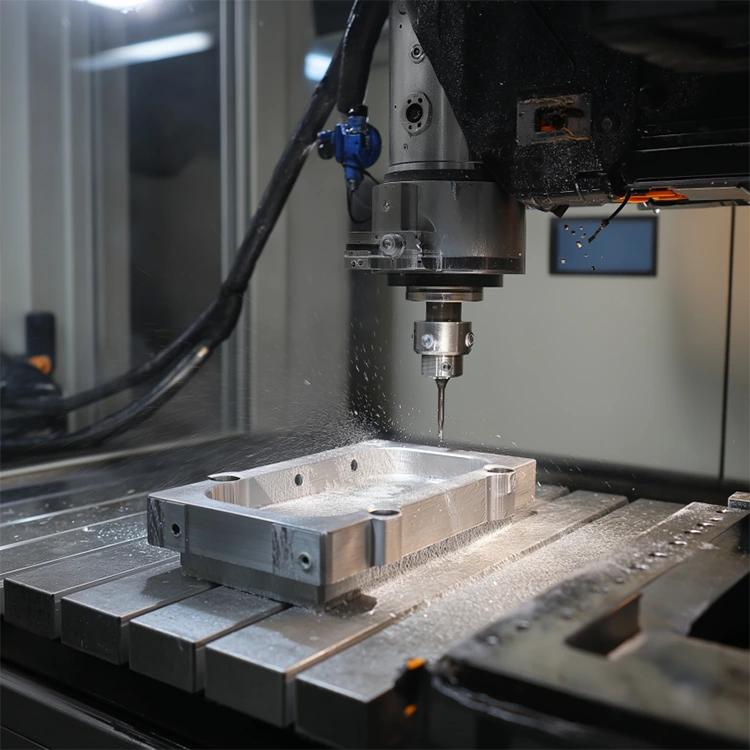
LK Group’s LHU-500 horizontal 5-axis mill-turn center, unveiled at CIMT2025, exemplifies this shift. Its proprietary AI system automatically generates optimal toolpaths based on 3D CAD models and material properties before processing; during operation, it adjusts feed rates and spindle speed in real-time by monitoring cutting force and vibration data, extending tool life by 20% compared to traditional systems . Aeronautical part manufacturers using this equipment have reported a 35% efficiency boost and a 40% reduction in defect rates.
Digital twin technology further amplifies this advantage. Leading heavy industry enterprises now build virtual replicas of milling workshops to simulate 1,000+ processing scenarios, pre-empting issues like fixture stress concentration and avoiding physical trial-and-error losses of up to $2 million annually. "We’ve eliminated 80% of manual parameter adjustments—AI now makes 120+ real-time decisions per minute during milling," noted an LK Group technical director.
Ultra-Precision Revolution: Chasing Nanometer-Level Accuracy
As high-end equipment demands push tolerance requirements to the nanoscale, CNC milling has transcended micron-level precision to enter the ultra-precision era. A hybrid technology combination—"superhard tools + laser compensation + magnetic suspension spindles"—has become the industry standard for critical components.
For semiconductor wafer molds requiring ±5 nm accuracy (supporting 3 nm chip processes), manufacturers now deploy CBN (cubic boron nitride) 刀具 paired with laser interferometers that correct errors in real-time. Magnetic suspension spindles, operating at 100,000 rpm, eliminate mechanical friction, reducing surface roughness from Ra 0.8 μm to Ra 0.05 μm. This breakthrough has also solved long-standing challenges in processing superhard materials like titanium alloys and carbon fiber composites: combining EDM wire cutting with laser shock peening has raised part qualification rates from 60% to 95% for new energy vehicle structural components .
LK Group’s GP5 series 5-axis gantry mill, designed for large molds, further demonstrates precision capabilities. Its integrated column structure and pre-tensioned ball screws achieve positioning accuracy of 0.005 mm and repeatability of 0.003 mm, handling workpieces up to 90 tons while maintaining consistent surface quality across complex curved surfaces.
Green Transformation: Low-Carbon Practices Become Profit Drivers
Sustainability has evolved from compliance to a competitive edge, with lifecycle technologies delivering both environmental and economic benefits. The industry is moving beyond end-of-pipe treatment to embed green design in every link of milling production.
Coolant management innovations lead the charge. Minimal quantity lubrication (MQL) systems and cryogenic cutting (using liquid nitrogen/CO₂) have reduced cutting fluid consumption by 90% in leading workshops. A precision parts manufacturer in the Pearl River Delta reported 25% lower energy use and higher accuracy after adopting intelligent coolant spray systems and parameter optimization. Meanwhile, waste recycling programs are gaining traction: one aerospace parts plant cut tool and material costs by 30% through AI-powered tool wear prediction and automated chip sorting for alloy recovery.
Energy-efficient equipment design is another focus. New milling machines with permanent magnet synchronous motors and optimized transmission structures achieve 95% motor efficiency—10 percentage points higher than 2023 models. A mid-sized manufacturer using these machines saved over 12,000 kWh annually, translating to $1,500 in electricity costs. "Green milling isn’t just eco-friendly—it’s 15-20% cheaper in operational costs," confirmed a sustainability manager at a leading energy equipment firm.
Market Dynamics: Flexibility Meets Regional Demand
The industry’s growth is fueled by two parallel trends: rising demand for small-batch customization and regional manufacturing clusters. Modular milling machines, with standardized interfaces for spindles and fixtures, now enable tooling changes in 10 minutes—down from hours—allowing 3C manufacturers to switch between phone frames, camera modules, and earbud casings on the same line. This flexibility has cut small-order lead times from 15 days to 3 days.
Regionally, China’s Yangtze River Delta and Pearl River Delta dominate global high-end milling, contributing 62% of national output. The Yangtze River Delta specializes in aerospace and automotive precision parts (with 5.2 milling machines per km²), while the Pearl River Delta leads in consumer electronics molds (4.8 machines per km²)—both far exceeding the global average of 2.3. Policy support, including 4.5% R&D subsidies for intelligent equipment, has accelerated domestic substitution: China’s homegrown CNC milling systems now hold 68% market share, up from 42% in 2023.
Challenges & Outlook: Talent and Technology Convergence
Despite progress, the sector faces hurdles. The shortage of senior technicians—who account for just 3.5% of China’s CNC workforce, vs. 35% in developed nations—has pushed salaries for AI-savvy mill operators to $30,000 annually. Additionally, 45% of high-end components like precision gratings still rely on imports, posing supply chain risks.
Looking ahead, 2026 will see deeper convergence of technologies: quantum sensing could push precision to sub-nanometer levels, while AI-driven autonomous programming may compress process design from hours to minutes. "The future CNC miller won’t just operate machines—they’ll manage digital twins and optimize AI models," predicted a Siemens industry analyst. For now, 2025’s focus on intelligence, precision, and sustainability is cementing CNC milling’s role as the backbone of next-generation manufacturing.

Related News
- What Makes Complex 5 Axis CNC Machining Parts the Backbone of Advanced Manufacturing?
- Why High Tolerance Titanium Turned Parts Are the Backbone of Aerospace and Medical Innovation?
- Why Are 5-Axis CNC Machined Auto Parts the Smart Choice for Complex Automotive Components?
- Why Are CNC Aluminum Turned Parts the Preferred Solution for Lightweight, High-Precision Components?
- Can Fast 3D Printed Prototypes Really Accelerate Your R&D and Reduce Costs?
- CNC Prototype Metal Components: Why Are They Essential for Your Next Project
Leave me a message